About
History
When the Pontifical Biblical Institute was founded in Rome in 1909, a branch in the Holy Land was already being considered.

St Ignatius of Loyola in the Holy Land
In 1523, shortly after his conversion, Ignatius of Loyola fulfilled a long-held desire to visit the Holy Land. Leaving Venice in August, he arrived in Jaffa and made his way to Jerusalem, where he entered the Holy City on 4 September.
Ignatius spent several days visiting the holy places associated with the life, death, and resurrection of Jesus. His pilgrimage was marked by a profound desire to remain in the Holy Land and to serve there, but the Franciscan custodians of the holy places advised him to return to Europe. Obedient to their counsel, he eventually left Jerusalem and returned to Venice.
His brief pilgrimage had a lasting influence on his spiritual journey. The experience of walking in the footsteps of Jesus in the land of the Gospel became an important part of Ignatius’ spiritual heritage and contributed to the geographical and incarnational character of his spirituality. The desire to encounter Christ in the concrete places of his earthly life would remain deeply connected with the Ignatian tradition and with the Jesuit presence in the Holy Land.
The desire to return to the Holy Land remained alive in Ignatius. In 1537, after gathering the first companions who would eventually form the Society of Jesus, Ignatius and his companions resolved to place themselves at the service of the Pope and, if possible, to go to Jerusalem. They travelled to Venice with this intention, but the outbreak of war between Venice and the Ottoman Empire made the journey to the Holy Land impossible. The companions were eventually ordained priests in Venice, and the Society of Jesus was formally approved by Pope Paul III in 1540.
Ignatius’ pilgrimage of 1523, together with the unrealised journey of the first companions, became an enduring part of the Jesuit spiritual memory of the Holy Land. His experience of walking in the places of the Gospel contributed to the profoundly incarnational character of Ignatian spirituality, in which the contemplation of Christ is closely connected with the concrete places and events of his earthly life.
Our history
- 1913Fr Alexis Mallon in JerusalemFather Alexis Mallon, S.J. came to Jerusalem in 1913 to set up such a branch but was prevented from doing so because of the War of 1914–18. He returned in 1919.
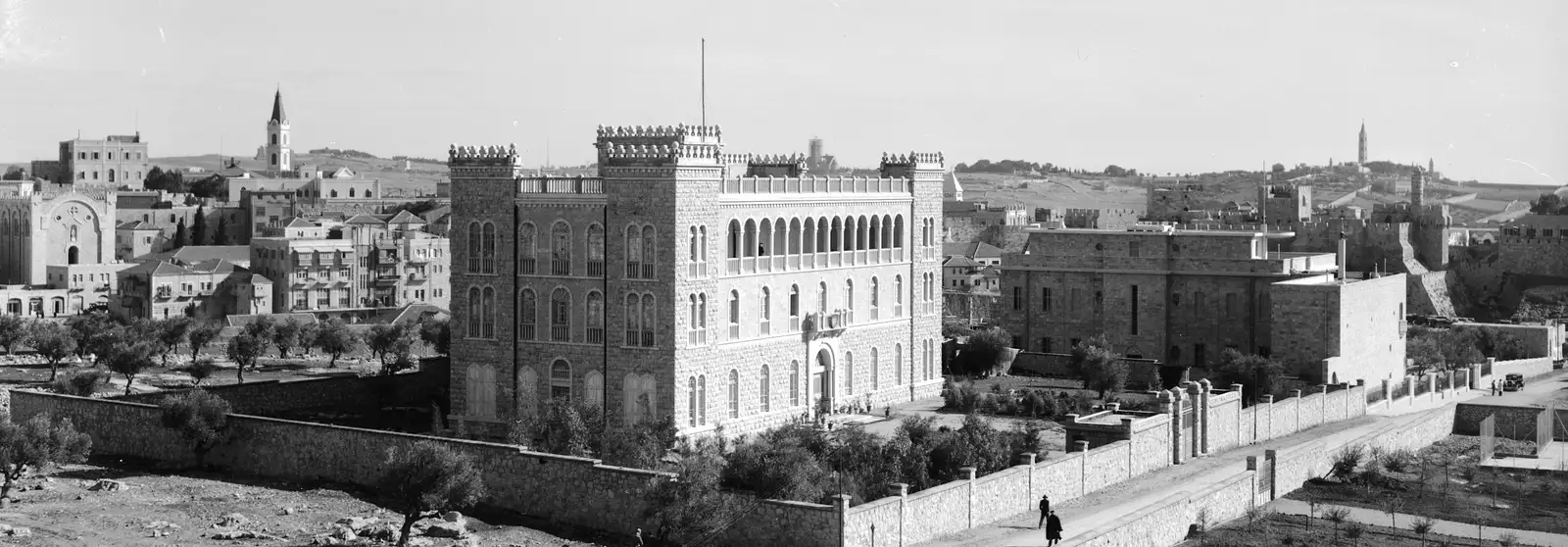
- 1927The building inauguratedThe cornerstone of the building was laid in October 1925 and the inauguration took place in July 1927.
- 1927–38Students from RomeFrom 1927 to 1938, a few students from the Biblicum in Rome came to Jerusalem each year during the last semester of their studies.
- 1952Open to other studentsBeginning in 1952, the Jerusalem branch opened its doors to other biblical students.
- 1969–72Courses in the biblical languagesCourses in the biblical languages were organized from 1969 to 1972 for students preparing to attend the Biblicum in Rome.
- 1975The Hebrew UniversitySince 1975, a programme of seven months is offered by the Hebrew University of Jerusalem to students of the Biblicum who have completed in Rome the introductory course in biblical Greek and Hebrew.
- 1986The École BibliqueSince 1986, the École Biblique of Jerusalem receives for one semester other students from the Biblicum in Rome who are halfway through their studies. In addition to the study of biblical Aramaic, this programme includes courses in exegesis.
- 2000The Studium Biblicum FranciscanumIn 2000, the Studium Biblicum Franciscanum started to offer each year in September a course in biblical archaeology to a significant number of students from the Pontifical Biblical Institute. The course is currently taught by professors of the Biblicum.
- 2024Part of the GregorianFollowing the integration of the Pontificio Istituto Biblico, the Pontificio Istituto Orientale, and the Collegium Maximum, the PBI serves as the Jerusalem campus of the Pontifical Gregorian University (PUG).
- 2027The centenaryA hundred years after the house opened, the Institute celebrates its centenary with a year of courses and events in Jerusalem.
This new chapter enables the PBI to offer PUG students a broader and richer academic programme, strengthened by partnerships with local academic institutions. Moving forward, we hope to extend this academic offering to the wider international network of Jesuit universities (IAJU).