
 G4
G4Cornets, miniature vessels and repaired pottery
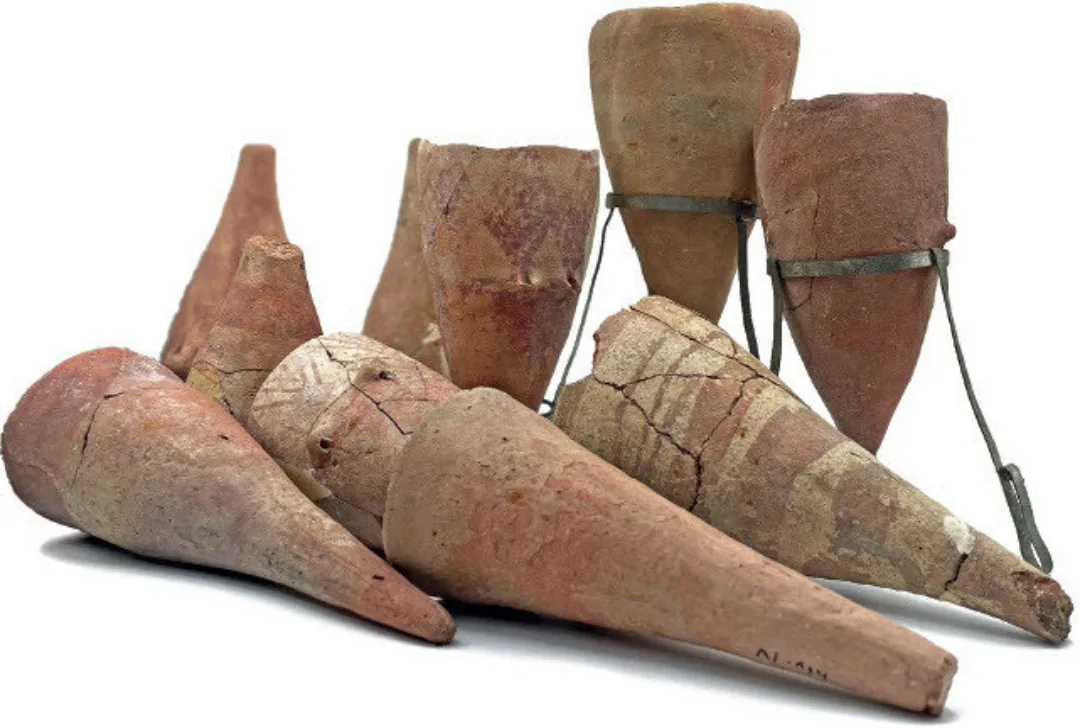
The first wooden showcase [G4] on the left-hand wall as you enter contains some of the more characteristic pottery from the site, which deserves some comment.
Contents of the showcase
- Shelf 1: A. Cornets · B. Handled, short-necked jars
- Shelf 2: A. Cornets · B. Repaired vessels from Ghassul
- Shelf 3: A. Goblets · B. “Mini-vessels” and spoons
- Shelf 4: A. Handled storage jar · B. Handled storage jar
Cornets
Because of their unusual shape, virtually unknown from any other archaeological period, these vessels were called cornets by the early excavators of Ghassul. Many scholars have argued that these are drinking vessels, despite their unstable bases. A number of unusual pointed depressions were found inside the Chalcolithic temple at En Gedi, which may have been used to hold cornets.
The most recent study, by Sharon Zuhovitzky (see below), has argued for them as a “vigil object”, clearly tied to a ritual function.
Repaired vessels
Repaired pottery is found at most Chalcolithic sites, but Teleilat Ghassul has a higher number than other sites. The recycled pots at Ghassul were carefully selected from among the broken vessels. Most were bowls, which were repaired by drilling holes in two large sections with a small borer and tying the sections together with vines or reeds at their perforations. In addition to bowls, cornet sherds were recycled: they were reused as amulets after their edges were smoothed and holes for fastening were drilled.
Spoons
Spoons are a rather rare type of object from Chalcolithic sites: eighteen (at least) of the 52 known examples, from sixteen sites, come from here (see Rosenberg et al., below). We take for granted today that spoons form part of our dining habits, but this was not the case in antiquity. Scholars have rightly asked, considering the rarity of these items, whether these spoons were linked with specific meals or events, or perhaps with particular dishes.
Additional reading
- D. Rosenberg, S. Gur-Arieh, M. Pearl & H. Ahituv, “(Don’t) Use Your Hands: The South Levantine Late Chalcolithic (ca. 4500–3900 cal BC) Spoons and Their Significance”, Humans 4.4 (2024) 385–399 (open access): doi.org/10.3390/humans4040025
- S. Zuhovitzky, P. Waiman-Barak & Y. Gadot, “The Cornets of Teleilat Ghassul as a Vigil Object”, Tel Aviv 52.2 (2025) 159–185 (open access): doi.org/10.1080/03344355.2025.2546274
- Accession
- G4
- Period
- Chalcolithic
- Material
- Pottery
- Findspot
- Teleilat Ghassul (Jordan Valley, north of the Dead Sea)
- Teleilat Ghassul excavations
- 1929–38, 1959–60
- On display
- Main hall, first showcase on the left-hand wall